
We spent 10 years helping clients grow through digital marketing. Then we used Claude Code to build our own SaaS product in six weeks. Here's the unfiltered story of how a performance marketing agency shipped a generative engine optimisation platform, without hiring a single developer.
Twelve months ago, if you'd told us that ClickedOn would ship a production SaaS product built almost entirely with an AI coding agent, we'd have smiled politely and changed the subject. We're a digital marketing agency. We run Google Ads campaigns, optimise websites for search, and manage millions in ad spend for our clients. We're not a software company. But in early 2026, something shifted. The marketing landscape was changing faster than agencies could adapt. AI-powered search engines were reshaping how people discover businesses. Our clients needed a new kind of tool, one that didn't exist yet. So we built it ourselves.
Why we needed to build Geo
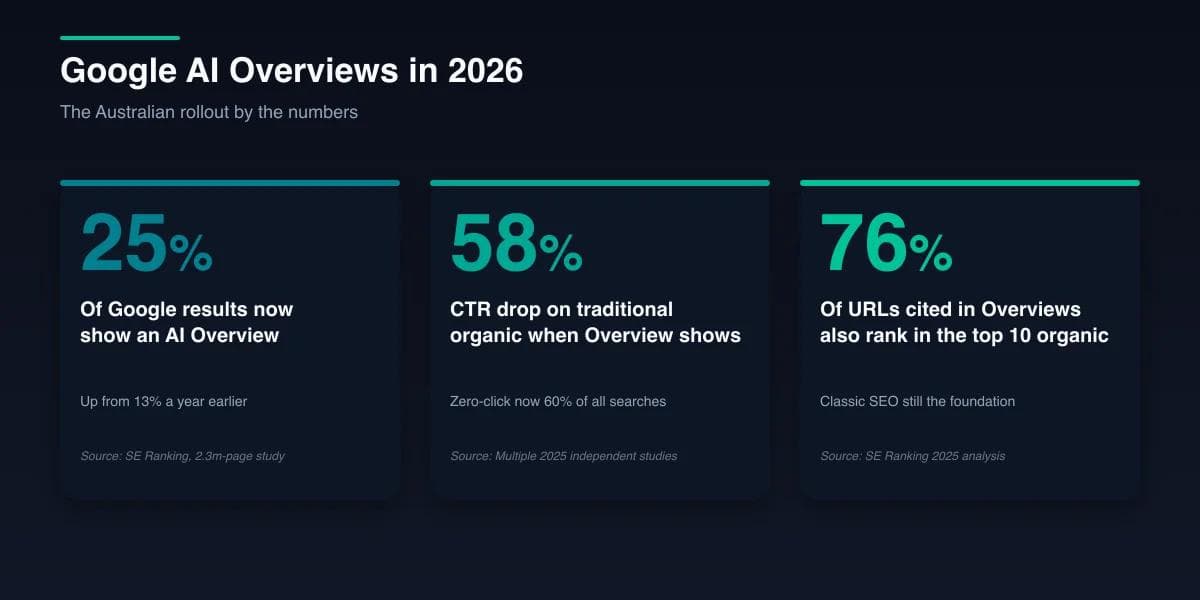
For a decade, we've watched the search industry from the inside. We've managed Google Ads campaigns as a Google Premier Partner (five consecutive years, top 3% of agencies globally), built SEO strategies for brands like Smartline, WorldFirst, and The Man Shake, and watched those clients collectively achieve over A$1 billion in trade sales. But 2025 changed the game. AI search adoption exploded. Sessions referred by AI engines grew over 500% year-on-year. Platforms like ChatGPT, Google AI Overviews, Perplexity, and Claude weren't just answering questions. They were becoming the primary way people discover businesses.
What is Claude Code?
Claude Code isn't your typical autocomplete tool. Launched by Anthropic in early 2025, it's a terminal-native coding agent that reads your entire codebase, understands the context, and executes complete development tasks, from writing API endpoints to generating test suites to deploying code. By early 2026, Claude Code had reached $2.5 billion in annualised revenue, making it the fastest product ramp in enterprise software history. At Anthropic, 70 to 90% of all code is now produced by Claude Code. Developers report productivity gains of 2 to 3x.
Choosing the tech stack
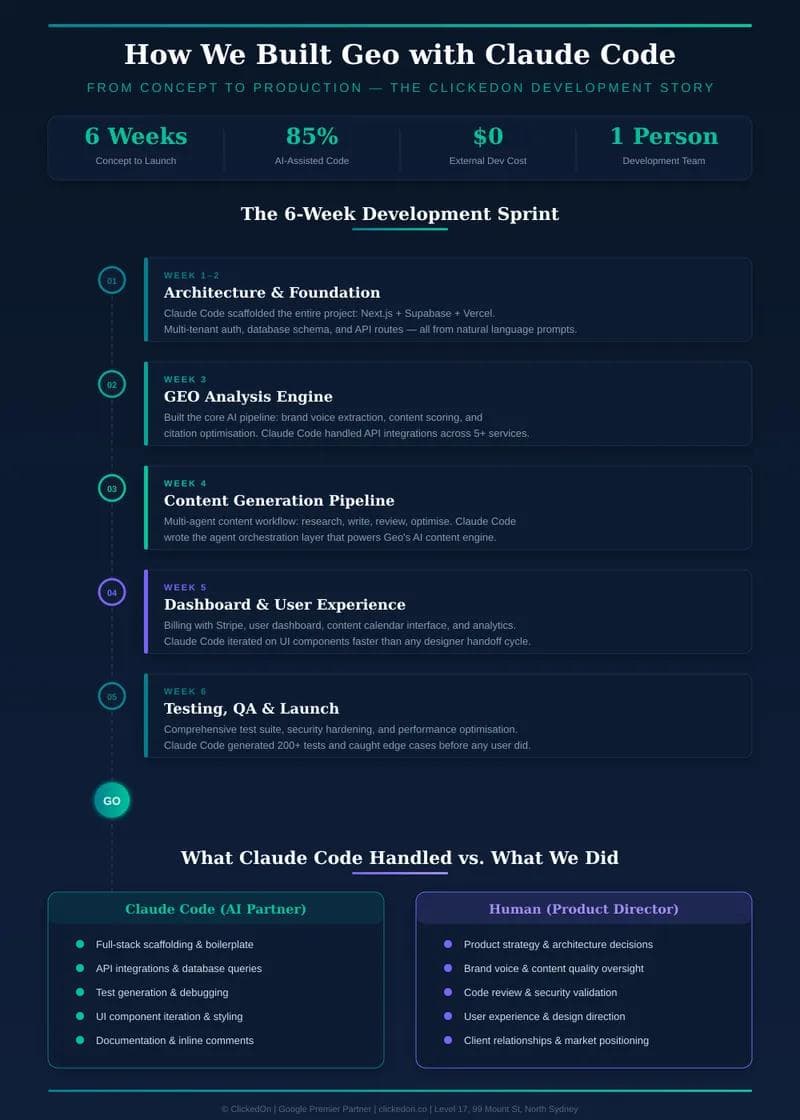
The first decision was the tech stack. We described what we needed (a multi-tenant SaaS with authentication, a content management pipeline, and integrations with search APIs) and Claude Code recommended Next.js, Supabase for the database and auth layer, and Vercel for deployment. Within hours, Claude Code had scaffolded the entire project structure. The CLAUDE.md file (a project-level configuration document that tells Claude Code about your architecture, conventions, and rules) is the single most important investment you can make. We spent a full day writing ours before touching any code.
Building the AI analysis engine
In week three, our marketing expertise became the critical advantage. We knew exactly what the AI analysis engine needed to evaluate because we'd been doing it manually for clients for years: content structure, citation potential, brand authority signals, schema markup, and technical accessibility for AI crawlers. Claude Code translated our domain knowledge into working code. We described the scoring logic in plain English and Claude Code built the pipeline, complete with error handling and logging.
Multi-agent content workflow
Geo's core capability is a multi-agent content workflow: research, write, review, optimise. Each stage uses a different AI persona with specific instructions, much like how an agency team operates. Claude Code built the agent orchestration layer that coordinates these AI personas, handling API calls, maintaining context between agents, implementing retry logic, and streaming responses to the frontend.
Testing and quality assurance
In the final week, Claude Code surprised us most. We asked it to generate a comprehensive test suite, and it produced over 200 tests covering API endpoints, authentication flows, edge cases, and integration scenarios. It caught issues we hadn't considered, including rate limiting edge cases, timezone handling for Australian businesses, and session management quirks. One practical tip: build the feature first, then write the tests. When we tried test-driven development with Claude Code, the AI would get caught in loops.
The 85/15 split
Claude Code handled roughly 85% of the work: full-stack scaffolding and boilerplate, API integrations and database queries, test generation and debugging, UI component iteration and styling, and documentation. We handled the remaining 15%: product strategy and architecture decisions, brand voice and content quality oversight, code review and security validation, user experience and design direction, and client relationships and market positioning.
Five lessons for agencies
Five lessons for agencies considering AI-assisted development: your domain expertise is the competitive moat. Anyone can ask Claude Code to build a generic SaaS, but what made Geo different is that we understood the problem space intimately. Invest heavily in the system prompt. Build features first, then write tests. The feedback loop is everything: describe, build, review, adjust within minutes. And don't skip the human review. Every commit was reviewed, every security-sensitive function validated.
Building Geo wasn't just about shipping a product. It fundamentally changed how we work as an agency. We now understand AI development tools at a practitioner level. When we advise clients on AI and GEO strategy, we're speaking from direct experience. Whether you need a GEO audit, an AI visibility strategy, or a performance marketing partner who actually understands the technology, we'd love to talk.