AI visibility is your brand's presence in the answers generated by ChatGPT, Google AI Overviews, Perplexity, Gemini, Claude and Copilot. Most invisible brands share three fixable problems: AI crawlers blocked in robots.txt (usually by accident), content that answers no real buyer prompt, and no measurement loop. The fix takes one month: audit crawler access in week one, map prompts to pages in week two, rewrite and ship schema in week three, then measure and set a monthly cadence in week four. In our data at ClickedOn, AI-referred visitors convert at roughly 4.4x the rate of other channels, which is why the month is worth spending.
Run a test this afternoon. Open ChatGPT, turn on web search, and type the question your ideal buyer asks: "best [your category] for [your market] in Australia". If the answer names three competitors and skips you, the causes are usually boring. A robots.txt file nobody has reviewed since 2023, pages that answer no actual buyer question, and a team that has never once logged what the engines say about it. All three are fixable in 30 days, and most of the advice you have read about "optimising for ChatGPT" ignores them in favour of SEO in a new hat.
What AI visibility means in 2026
AI visibility is how often, and how favourably, your brand appears in AI-generated answers. It matters in 2026 because a growing share of buyer research ends in an answer rather than a list of links. The engines that count are ChatGPT, Google AI Overviews, Perplexity, Gemini, Claude and Copilot.
Brands absent from those answers never make the shortlist. The discipline of earning the citations is generative engine optimisation (GEO). You will also see AEO and LLMO used; they describe narrower slices of the same work, and the industry has not settled on one name yet. Anyone claiming the terminology debate is over is selling a rebrand.
Classic SEO gets you ranked. GEO gets you quoted. The two overlap heavily, which is good news for anyone who has spent years building organic equity: in our data at ClickedOn, 76% of URLs cited in Google AI Overviews also rank in the top 10 organic results. Your existing rankings are the raw material. The 30-day plan below shapes that material into something an engine can fetch and quote.
Why ChatGPT skips your brand: the five causes
Almost every case of a brand missing from ChatGPT answers traces back to one of five causes:
- Blocked crawlers. Your robots.txt file blocks the bots AI engines use to fetch pages, so your content cannot appear in live answers.
- No answer-shaped content. Your pages describe what you do but never directly answer the prompts buyers type.
- Weak authority signals. The engines find few mentions of your brand on sites they already trust.
- Missing structured data. Without schema markup, engines struggle to confirm who you are and what you sell.
- No measurement loop. Nobody checks what the engines say, so nothing gets diagnosed and nothing improves.
The first cause produces the strangest cases: strong sites, good rankings, zero citations. Start there.
Why you can rank on Google and still be invisible
Brand visibility in ChatGPT comes from two different systems, and the difference explains most of the confusion.
The first is training data, the static snapshot the model learned from. If your brand was small, new or quiet when that snapshot was taken, the model knows little about you. You cannot patch training data on demand, so stop worrying about it.
The second is live retrieval. When a user runs a prompt with web search enabled, ChatGPT fetches current pages, reads them and cites the ones that answer the question. This is the surface you can influence this quarter. It rewards pages that can be crawled, load cleanly, and put the answer near the top. Google's AI Overviews and AI Mode work from the same broad principle, drawing on Google's index.
Ranking helps with retrieval, but ranking alone does not finish the job. An engine still has to be allowed to fetch the page, and the page still has to contain a quotable answer. Those two conditions fail far more often than rankings do, which brings us to the least glamorous section of this article.
Are you blocking the AI crawlers by accident?
When AI training bots first appeared, plenty of organisations blocked them wholesale and never revisited the decision. The block made sense as a training opt-out. It quietly became a visibility problem once the same companies' engines started fetching pages to build cited answers.
The vendors now separate those functions, and the detail matters:
- OpenAI runs separate crawlers for separate jobs. GPTBot gathers training data, while OAI-SearchBot is what surfaces sites in ChatGPT search results. Blocking training does not have to mean blocking search visibility, but if your robots.txt blocks both, you have opted out of ChatGPT answers without meaning to.
- Perplexity operates more than one crawler, including PerplexityBot and Perplexity-User, and they behave differently. Each can be managed individually in robots.txt.
- Anthropic documents its crawlers and separates training crawling, citation crawling and fetches triggered by a live user request. Each is blockable independently, which decides whether Claude can reference your pages.
- Google controls participation in AI features through existing Search settings rather than a separate system, so your current Search configuration is already making this decision for you.
The check takes five minutes. Open yourdomain.com/robots.txt in a browser and read it against each vendor's documentation above. You are looking for blanket disallow rules, and for blocks on the agents that power search and citations rather than just the training ones. If you find them, log a ticket with whoever owns the file. This is the fastest fix in the plan, and it is the one that most often surprises marketing teams, because the block tends to live with IT or a previous agency.
The 30-day AI visibility plan, week by week
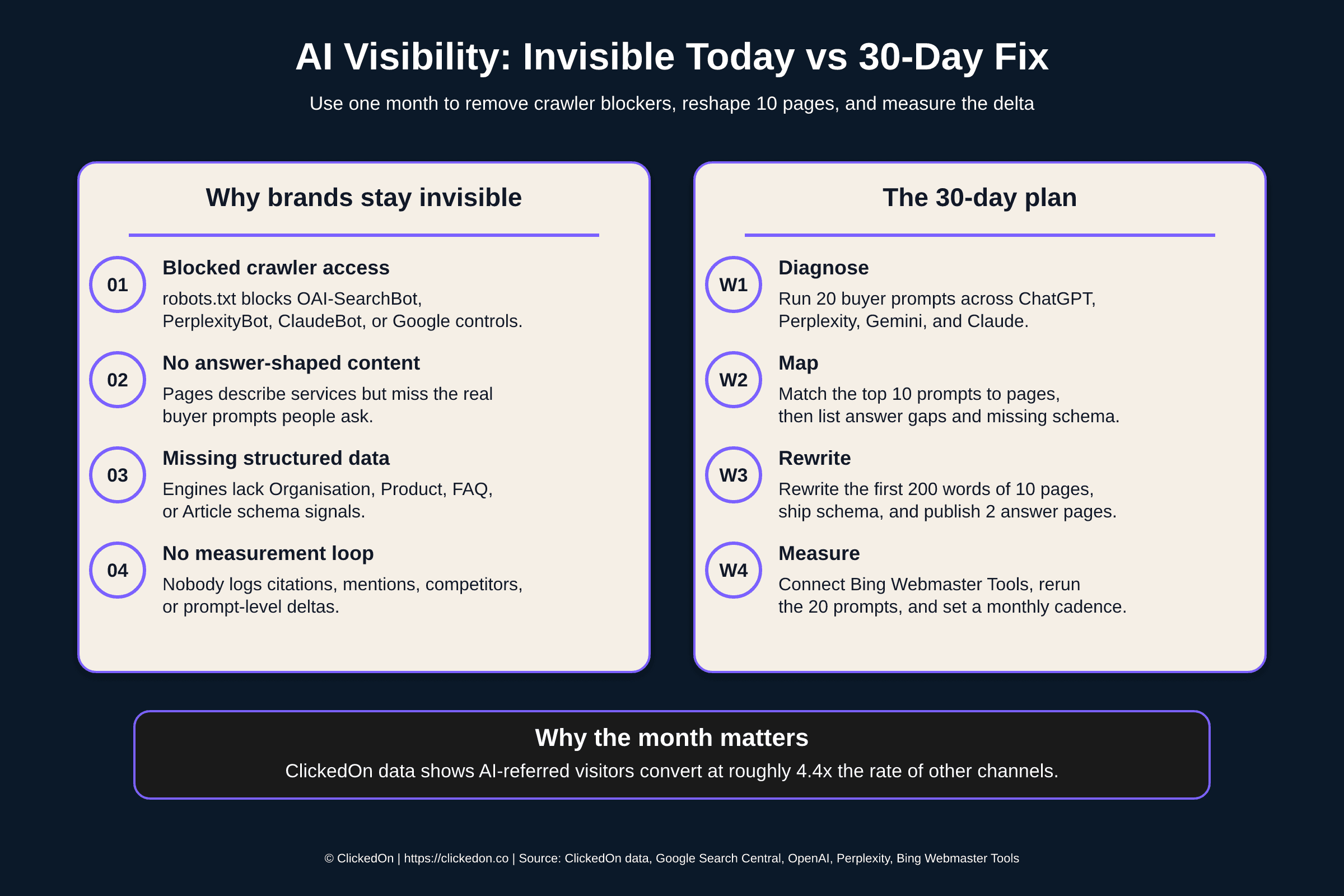
Improving AI visibility means making your pages easy for answer engines to fetch, quote and trust. The four levers are crawler access, answer-shaped content, authority signals and measurement. For most Australian brands with a functioning site, a focused 30 days covers the first pass on all four.
One caveat. There is no guaranteed formula for being cited in AI answers, whatever a vendor pitch says. What the month buys you is a clean baseline, the technical blockers gone, and ten important pages reshaped for answer engines. That combination moves the needle more often than any single tactic.
Week 1: diagnose
Write 20 buyer prompts: the questions people ask before they know you exist, rather than searches for your brand name. For a payments product that might be "best payment gateway for Australian ecommerce" or "Stripe alternatives for subscription businesses". Pull them from sales call notes and search query reports.
Run each prompt through ChatGPT with web search on, then Perplexity, Gemini and Claude. Log four things per prompt: was your brand cited, was it mentioned without a link, which competitors appeared, and which URLs earned the citations. A spreadsheet is fine (nobody is grading its formatting). This log becomes your baseline and your evidence for the next budget conversation.
Then audit crawler access as described above, and run your domain through the GEO Readiness Checker to catch the technical gaps a manual read of robots.txt misses.
Week 2: map prompts to pages
Take the ten prompts that matter most commercially. For each one, name the single page on your site that should be the answer. A prompt like "best accounting software for Australian trades" should map to a comparison or category page, never the homepage. Three outcomes are possible: the page exists and answers well, the page exists but buries the answer under scene-setting, or no page exists at all. Expect a lot of the second and third.
While you are in the content, list the schema types you are missing. Organisation and Article are the baseline; Product and FAQ apply if you sell products or answer common questions on the page. Structured data does the quiet work of confirming to an engine who is speaking and why the source is credible.
Week 3: rewrite and ship
Rewrite the first 200 words of your ten mapped pages so the direct answer comes first and the context follows. Answer engines quote passages that stand alone, so the opening of each page should read like the answer, with the evidence after it.
Publish two new pages for the prompts that had no home. Same shape: the answer up front, proof beneath it.
Ship the missing schema and run each page through the Schema Validator before you call it done. Broken markup helps nobody.
Week 4: measure and set the cadence
Connect Bing Webmaster Tools and open the AI Performance report it launched in public preview in February 2026. It shows how Copilot and other Bing-powered AI experiences use your pages, and it matters more than its name suggests because Bing's index feeds ChatGPT's live search. It also costs nothing, which settles the question of whether you need another tool this quarter. You do not.
Rerun the 20 prompts from week 1 and log the delta. Some prompts will already move. Others will take another month or two, and a few in contested categories will need the authority work that sits outside this plan. Record everything, set a monthly rerun in the calendar, and treat the log the way you treat a rank tracker: as a trend line, never a single reading.
For everything the engines will not show you, your analytics referral report captures sessions arriving from AI domains, and the prompt log covers what analytics cannot see. Between those two and Bing's report, a lean team can measure this without a new line item.
Should you run this in-house or bring in an agency?
Weeks one and two are in-house work, full stop. A marketing manager with four focused hours a week can write the prompts, run the tests and build the map. Doing it yourself also teaches you how the engines treat your category, and no report replicates that.
Bring in outside help when the mechanics outgrow the team. That looks like schema across hundreds of templates, a robots.txt dispute involving IT and a legacy agency, or a category so contested that answer-first pages alone will not earn citations. That is the work our generative engine optimisation services exist for, and none of it is needed in the first month. Run the month yourself first. You will brief any partner better for having done it.
Key takeaways
- Invisibility has boring causes. Blocked crawlers, pages with no direct answers, weak authority signals, missing schema and no measurement loop.
- Check robots.txt first. OpenAI, Perplexity, Anthropic and Google all document their crawlers separately. A training block from 2023 may be silencing you in search answers today.
- Rankings still matter. In our data at ClickedOn, 76% of URLs cited in Google AI Overviews also rank in the top 10 organic results.
- The plan is four weeks. Diagnose with 20 buyer prompts, map the top ten to pages, rewrite openings and ship schema, then measure and repeat monthly.
- Measurement is free. A prompt log, your analytics referral report and Bing Webmaster Tools cover a lean team's needs.
See where you stand before you spend the month
The fastest version of week 1 already exists as a tool. Run the free AI Visibility Audit at geo.clickedon.co and you will see where your brand is cited, and where it is absent, across ChatGPT, Perplexity, Google AI Overviews and Claude. It takes minutes and gives your 30-day plan its baseline.
If you would rather sharpen the craft week by week, the AI Wrap newsletter rounds up what moved in AI search every week, with the tactical detail left in.