ChatGPT ads in Australia: should they be in your FY27 media plan?
ChatGPT ads reached Australia on 17 April 2026, and self-serve buying followed on 22 May. Reported click-through sits near 0.91% against Google Search's 6.4%, so this is an early channel rather than a Google replacement. For most Australian businesses locking an FY27 budget, the move that holds up is a small ringfenced test for the right business types, with the larger spend going to organic AI visibility through GEO. Below: what the channel costs, how it compares to Google and Meta, and how to size it before 1 July.

ChatGPT ads have been live in Australia since 17 April 2026, and for most businesses setting an FY27 budget the honest answer is to ringfence a small test, not add a core line item. OpenAI began its ads test in the United States on 9 February 2026, then brought ads to Australia, New Zealand and Canada, the first markets outside the US. Reported click-through sits around 0.91%, roughly seven times lower than Google Search's 6.4% benchmark, so this is a young channel at an early stage. The larger and more durable FY27 play for most Australian businesses is getting cited inside the AI answer through generative engine optimisation (GEO), not only appearing in the sponsored box beneath it. What follows is the real cost picture, and a clear rule for whether and how much to budget before 1 July.
The channel most Australian businesses have not noticed yet
ChatGPT ads have been running in Australia for around two months, and most local businesses still have not noticed. The timeline is short. OpenAI began its US ads test on 9 February 2026. Australia, New Zealand and Canada followed on 17 April, chosen as the first international markets because local ChatGPT usage more than doubled in the prior 12 months. Then on 22 May, OpenAI added a beta self-serve Ads Manager, cost-per-click bidding, and Conversions API plus pixel measurement. That is the point the channel became usable for a business buying its own media.
The reason to decide now is timing, not novelty. The new financial year starts on 1 July, and that is when most Australian businesses lock their media budgets. So the useful question is not what ChatGPT ads are. It is whether they earn a line in your FY27 plan, and how big that line should be.
How much do ChatGPT ads cost in Australia right now?
Reported CPMs sit around 15 to 40 USD, cost-per-click bids start around 3 to 5 USD, and there is no minimum spend on the self-serve Ads Manager. Two caveats matter before you put those numbers in a spreadsheet. OpenAI has not separately disclosed Australia-level pricing, and the figures circulating are in US dollars as reported by partners and trade press. Treat them as directional, not as a rate card.
The performance side is where honesty earns its keep. Reported click-through is around 0.91%. Google Search sits near 6.4% on the standard benchmark, so ChatGPT's rate is roughly seven times lower. That gap reads worse than it is. A conversational surface where people are mid-decision behaves differently from a search results page, and the channel is barely a few months old. It is a different kind of buy at an early stage, not a broken one.
Pricing has moved fast, and in the advertiser's favour. CPMs reportedly opened near 60 USD at the US launch and have come down to roughly 15 to 40 USD, with some partners reporting 25 to 35. The original minimum spend, once quoted at 200,000 USD or more, has been removed on self-serve. That alone changes who can test. A year ago this was an enterprise-only buy. Now a mid-market brand can run a controlled experiment.
As a Google Premier Partner managing more than $12m in ad spend, here is how we read the comparison against the channels you already run.
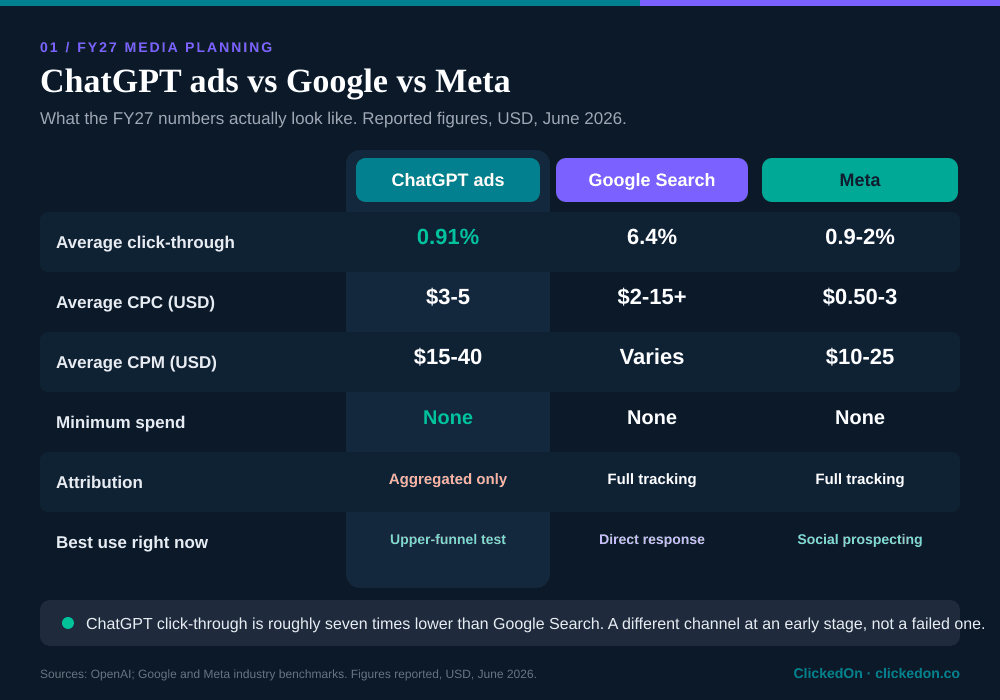
ChatGPT ads vs Google vs Meta: reported FY27 cost and performance. Source: OpenAI; Google and Meta industry benchmarks, June 2026.
One more point shapes the maths. ChatGPT advertising is cookieless from day one, and advertisers receive aggregated performance data only. Your conversation content stays private. You get post-click signal through the Conversions API and pixel, not the user's actual prompt. If attributed cost per acquisition is your only success metric, you will find ChatGPT harder to prove than Google today, which is exactly why the budget you assign it should be sized as a test.

What is the difference between a ChatGPT ad and a ChatGPT recommendation?
A paid ad sits in a labelled box below the answer, while an organically cited brand appears inside the answer itself, recommended by the AI with no label and no spend. Those two placements look nothing alike to the person reading them. A sponsored box is clearly marked, and people read it as advertising. A recommendation inside the response carries the AI's apparent endorsement, which is a different level of trust entirely. When ChatGPT names your business as the answer to "who should I use for this", that is worth more than a sponsored slot beneath it.
The two systems are separate, and OpenAI has been explicit about it: ads do not influence ChatGPT's organic answers or recommendations. Paying for placement does not buy you a recommendation. That single fact reframes the whole channel. The work that gets you inside the answer is generative engine optimisation, the same discipline that earns citations across ChatGPT, Gemini, Perplexity and Google AI Overviews. It is what our Geo platform measures and improves, and for most businesses it is the higher-priority investment.
Should you pilot ChatGPT ads now, wait, or skip?
It depends on your business type. Retail and considered-purchase brands with flexible KPIs can pilot now, lead generation and B2B can test cautiously with tight measurement, and transactional repeat-purchase and regulated categories should wait.
Business type FY27 move Why Retail, consumer and considered-purchase brands Pilot now (small) The Free-tier audience skews to early-stage researchers, so awareness KPIs fit the channel as it stands. Lead generation and B2B Test cautiously Conversational intent is rich, but prove it with tight measurement before moving real budget. Transactional, repeat-purchase Wait Direct-response economics need attribution the channel cannot yet give. Regulated (health, finance, sensitive) Wait Ad inventory is restricted near sensitive topics, so reach is thin and compliance risk outweighs the upside.
A few constraints sharpen those calls. Ads are restricted from appearing near sensitive topics such as health, mental health and politics, and they are not shown to users predicted to be under 18, so regulated categories face thin inventory even if they want in. The audience itself has a ceiling: ads only reach logged-in adults on the Free and Go tiers. Anyone on Plus, Pro, Business, Enterprise or Education sees nothing, which means a good share of senior B2B decision-makers, the people who pay to remove ads, are out of reach. That matters most when your buyer is exactly that person.
How much should you budget for ChatGPT ads in FY27?
Treat any ChatGPT ad spend as experimental test budget: ringfenced as a small percentage of your paid media, measured through the Conversions API and pixel, with exit criteria set before you start. A workable rule of thumb is to carve out a small, fixed test allocation you would not miss if it returned nothing, and keep it walled off from your proven performance budget. Set the exit criteria up front. Decide the cost-per-outcome the test has to beat, and the date it has to beat it by, so the call to continue or stop is made on numbers rather than enthusiasm.
One practitioner detail is worth knowing. The auction is relevance-weighted, so a sharper, more specific creative on a smaller bid can beat a lazy, big-budget ad. Spend is not the lever here that it is on some channels. The work is in the context hints and the creative match.
The larger and more durable FY27 investment, for most businesses, sits on the organic side. Money put into GEO compounds, because a brand that earns citations keeps earning them, while paid placements stop the moment the budget does. If you only have room for one AI line in the FY27 plan, make it organic visibility, and treat paid ChatGPT ads as the small experiment beside it.
The bottom line
So, should ChatGPT ads be in your FY27 media plan? For retail and considered-purchase brands with awareness goals, yes, as a small instrumented test you can stop without regret. For most other businesses, the channel is worth watching and worth a cautious experiment at most, while the real FY27 investment goes to organic AI visibility. Paid gets you a labelled box. GEO gets you inside the answer. Size both correctly, and you are planning for how Australians actually search now, not how they searched two years ago.
Find out where your FY27 budget works hardest
Want to know where ChatGPT ads fit your mix, and whether your brand is being cited in AI answers at all? Get a free AI visibility audit and a ChatGPT ads readiness check, and we will give you an honest read on where your FY27 budget works hardest. If you would rather start with the strategy, see how our GEO service works.
Key takeaways
- Live since 17 April 2026. ChatGPT ads reached Australia ahead of most markets, with self-serve buying added on 22 May.
- An early channel, not a Google replacement. Reported click-through of 0.91% sits roughly seven times below Google Search's 6.4%.
- Cost has opened up. CPMs are down to a reported 15 to 40 USD and the old 200,000 USD minimum is gone on self-serve, so a mid-market brand can now test.
- Paid box versus organic citation. A sponsored ad is labelled and easy to skip; an organic recommendation inside the answer carries the AI's apparent endorsement and no ad spend.
- Pilot by business type. Retail and considered-purchase brands can test now, B2B and lead gen cautiously, transactional and regulated categories should wait.
- Budget it as a test. Ringfence a small percentage, measure through the Conversions API and pixel, and set exit criteria before you start.
- GEO is the durable FY27 play. Organic AI visibility compounds; paid placements stop when the budget does.
Frequently asked questions
Are ChatGPT ads available in Australia?
Yes. ChatGPT ads have been live in Australia since 17 April 2026, and self-serve buying through the beta Ads Manager arrived on 22 May 2026. Australia was among the first international markets, alongside New Zealand and Canada.
How much do ChatGPT ads cost?
Reported CPMs sit around 15 to 40 USD and cost-per-click bids start around 3 to 5 USD, with no minimum spend on the self-serve Ads Manager. These figures are reported in US dollars and have not been separately disclosed for Australia, so treat them as directional.
Are ChatGPT ads worth it for Australian businesses?
For some. Retail and considered-purchase brands can run a small, ringfenced test now with awareness-stage KPIs. Many other businesses get more value from organic AI visibility first, since being recommended inside the AI answer carries more trust than a sponsored box and does not stop when the budget does.
Do ChatGPT ads work like Google Ads?
Not closely. Click-through is far lower, around 0.91% against Google Search's 6.4%, the environment is cookieless, and reporting is aggregated rather than fully attributed. That suits experimental test budgets rather than core performance spend at this stage.
Will paying for ads help my brand get recommended by ChatGPT?
No. OpenAI keeps ads separate from organic answers, so a recommendation inside the response comes from generative engine optimisation, not from ad spend. Paid placement and organic citation are two different things.